
The Phoenician Scheme is about “the gap”, and how Zsa Zsa attempts to cover it.
I remember watching Bunuel’s The Discreet Charm of the Bourgeoisie and enjoying it but also being confused by it. I read in an analysis later that if I wanted to understand the film, I had to pay attention to the dreams themselves.
A little bell went off in my head upon subsequent viewings of The Phoenician Scheme and I realized I was treating Zsa Zsa’s dreams the same way I treated the dreams in The Discreet Charm of the Bourgeoisie, as secondary. Those black and white “dream” sequences, if that’s what they are, are truly the backbone of the film.
The first near death experience that Zsa Zsa experiences in the film, or the one we witness at least, is the opening plane crash. He is presumed dead. The first “dream” sequence (I’m calling them dream sequences here but there is an argument to be made that he is in limbo) Zsa Zsa is met with a jury. “Who is this man?” They ask. Surely they couldn’t be talking about Zsa Zsa, he is after all, a powerful man of wealth. He looks to his side and sees his grandmother. “I don’t know you,” she says. His own grandmother. The casket is open to reveal Zsa Zsa as a child and he is awakened.
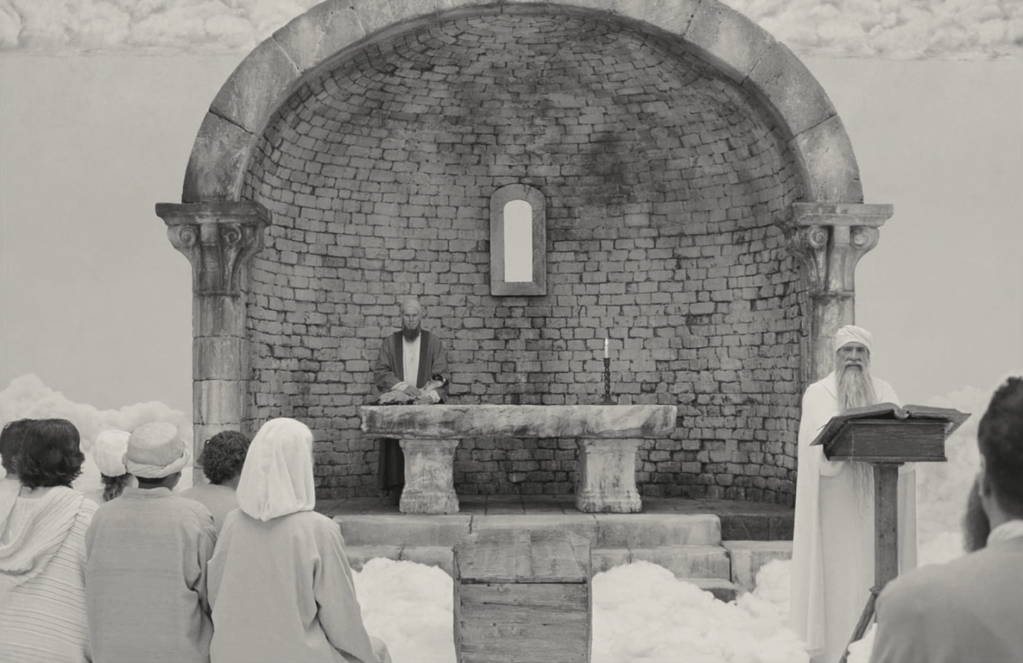
This is his first realization that his power, wealth, and work may be insignificant and amount to nothing. That’s a scary thought for him. He must ensure his legacy lives on. His response to this dream? He summons Liesl, a daughter, a thread he abandoned, to become his heir. And in order for his legacy to matter, he must complete his grand project.
Fast forward and we find his second dream comes right after Zsa Zsa truly opens up about his near death experience. After Leland (Tom Hanks) sinks a shot to come close to sealing his and Reagan’s (Bryan Cranston) win, Zsa Zsa is silent in contemplation before he says simply, “I almost died.” A revelation. He then reveals to Liesl that she’s the only child he wished to be a proper father to. He says that she was named after his grandmother and recalls, “she didn’t recognize me.”
After noticing Zsa Zsa’s moment of vulnerability, Liesl stops Prince Farouk from taking his shot and performs a quick prayer. Prince Farouk proceeds to makes a miracle granny shot, and we are ushered into his second dream sequence.
In his second dream, Zsa Zsa is carrying a dead stag riddled with arrows and presents it in front of three women (presumably his three ex-wives.) He is a provider. Food perhaps. He cuts open the stag in front of the three women and gold coins proceed to pour out of the stag. The middle wife, presumably Liesl’s mother says, “Good Husband. What tribute is this?” He responds, “money,” his idea of being a provider. The middle wife says, “She’s not your daughter.” He awakens.
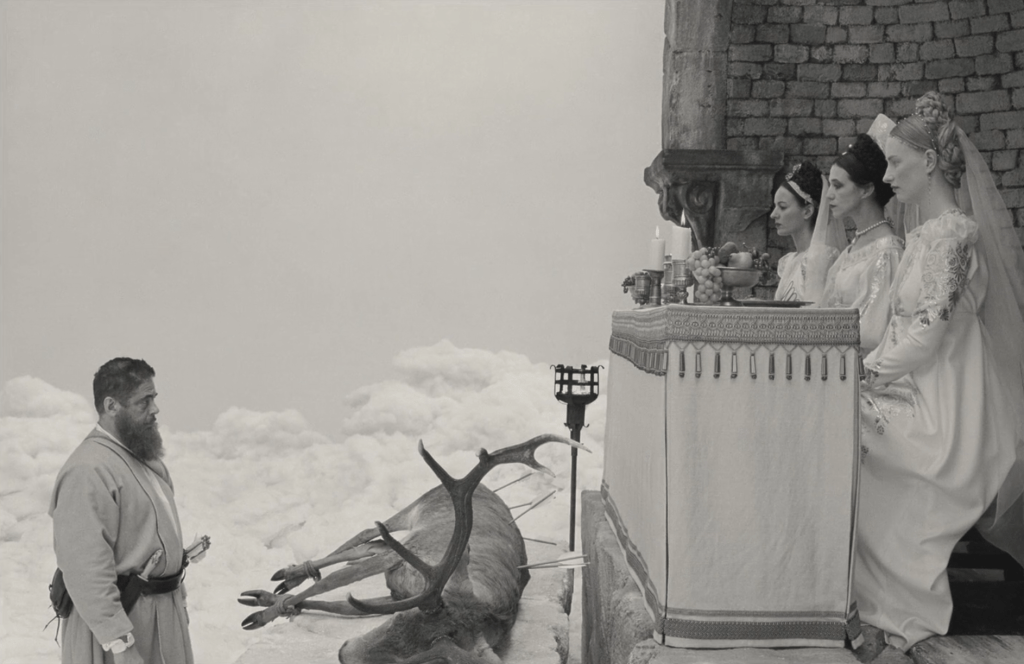
Zsa Zsa is beginning to understand that his money may have never been as good of a gift as he though. On the plane, where he awakens we catch probably the most important line in the entire film. A line that sparks Zsa Zsa’s true revelation. He asks Liesl what she prayed for to get the Prince to make that impossible shot.
She delivers the important line, “It’s not witchcraft. The phrasing of it, which I don’t recall, doesn’t matter. What matters is the sincerity of your devotion.”
Zsa Zsa stares, then slowly points at her. “That’s it.” / “That’s what?” / “No, that’s it.” / “What?” / “That’s it.”
Zsa Zsa here realizes that his actions mean nothing, unless he is truly sincere about the things he does. He wants to build some revolutionary infrastructure to revolutionize Phoenicia, he wants to repent and be a good father to Liesl so he buys her gifts, but none of that amounts to anything unless he is truly sincere to his devotion.
After Zsa Zsa is shot, he meets with Marty and is given a blood transfusion. Another near death experience. The third dream occurs here. In the dream, a young Liesl recounts her experience with Zsa Zsa’s tumultuous relationship with her mother in front of an audience. The memory is a violent one. Zsa Zsa is in chains amongst the audience. He looks at the chains and asks, “am I on trial here?”
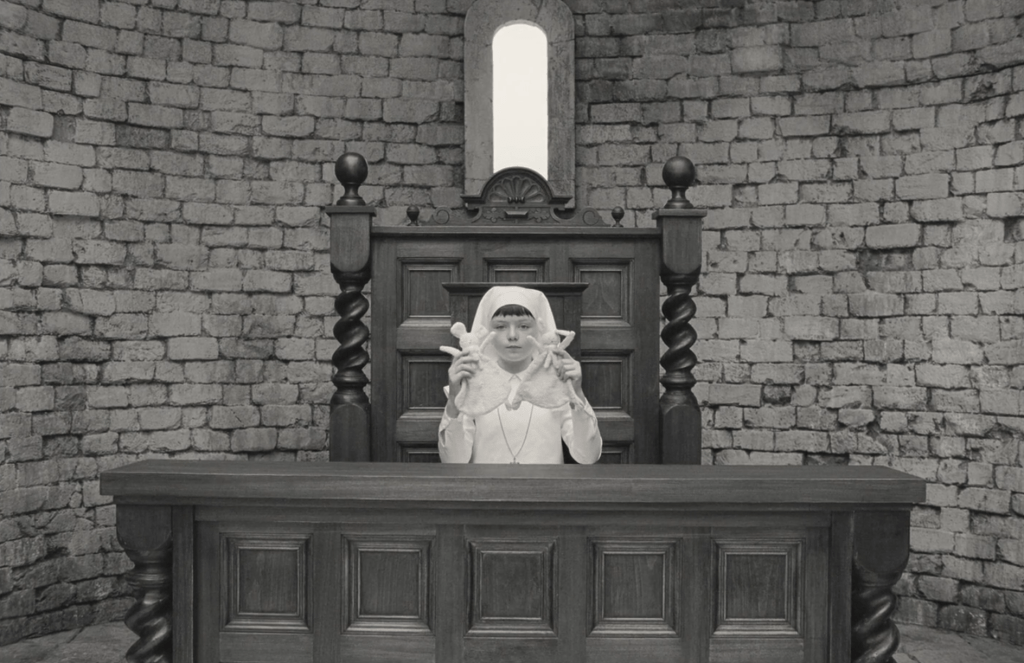
When he awakens, presumably feeling guilt, he immediately reveals to Liesl that what he is about to tell her is probably going to anger her. He says that he didn’t kill her mother but he may have set off the chain of events that lead to her death. She was one take lovers, one of which being her Uncle Nubar. Out of anger, Zsa Zsa tells Nubar that she had also slept with his administrative assistant. Both the administrative assistant and her mother are found dead shortly after. Revealing this information to Liesl is repentance for Zsa Zsa.
The fourth dream comes to us after Zsa Zsa drowns in quick sand. Again, another near death experience. In the fourth dream, Zsa Zsa prays before God (Bill Murray). Zsa Zsa is looking for a handout here. God holds out both fists. Zsa Zsa chooses one only for God to reveal nothing. God leaves Zsa Zsa by saying, “The yield of Adam’s loins crucified my only begotten son.” God’s creation sets off a chain of events that lead to his son’s crucifixion: divine tragic irony. Zsa Zsa understands here in a reflexive moment for him that his yields, completing his big project, is not what is going to save him, rather it is the exact thing that is going to kill him.
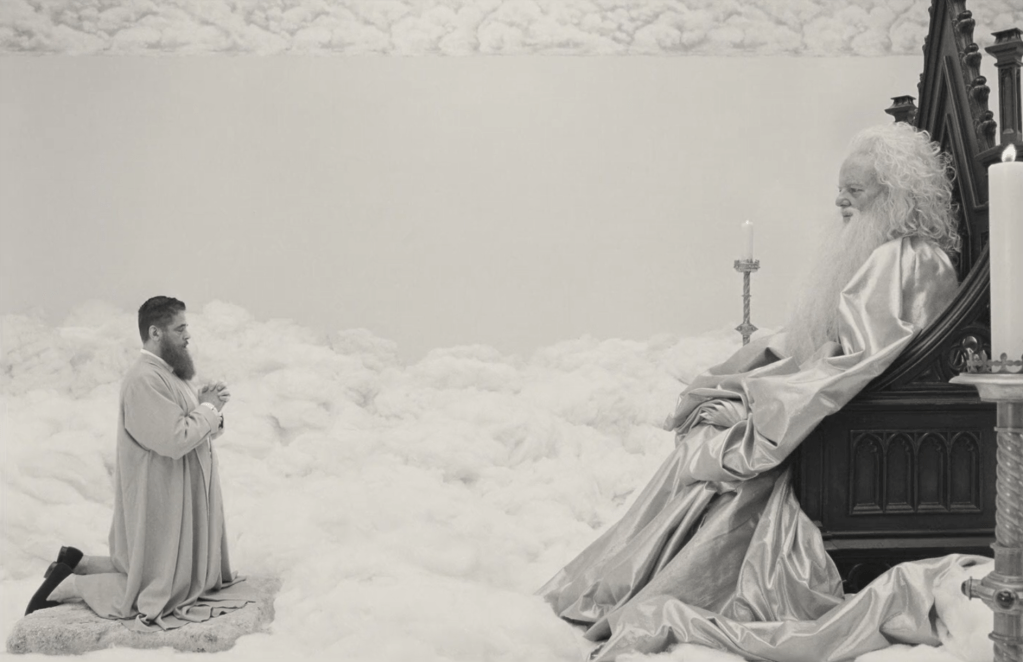
After this dream and his revelation, Zsa Zsa decides to no longer use slave labor, end the famine, and give use the entirety of his to cover the gap. Zsa Zsa is finally displaying sincerity to his devotion.
The final dream, after Nubar explodes himself with a hand grenade, sees Zsa Zsa and Liesl ascending stairs in heaven. They are met with a pyramid (the one his father always wanted to be buried in), and they place his fathers ashes inside of it. They seal away ugly characteristics he inherited from his father, the man whose motto was, “who can lick whom?” Zsa Zsa no longer carries this with him.

As they seal his ashes in the pyramid, Liesl delivers here another important line in the film. She says, “When I pray, no one answers. I only pretend he does. Then I do whatever I think God probably would’ve suggested. Usually, it’s obvious. Amen.”
Throughout the film, Zsa Zsa has receives revelations in ways to repent and become better through these divine dream sequences. Liesl’s line simply tells Zsa Zsa, “you don’t need to seek God’s guidance to do the right thing, because the right thing is always obvious.” A way forward for Zsa Zsa.
In the end, Zsa Zsa would go on to live a simple life with Liesl doing what he truly loves (as stated earlier in the film), cooking and doing dishes. The gap in this film started as a business gap. A financial gap. Zsa Zsa attempts to fill it with business plotting and scheming–by “fiddling” with it. By the end of the film, Zsa Zsa realizes that the true gap (and this might sound cliche and corny) was an internal one. Instead of filling the financial gap with his schemes, he fills a gap within himself with sincere devotion to himself and Liesl.

 NEW REVELRY
Leave a comment