
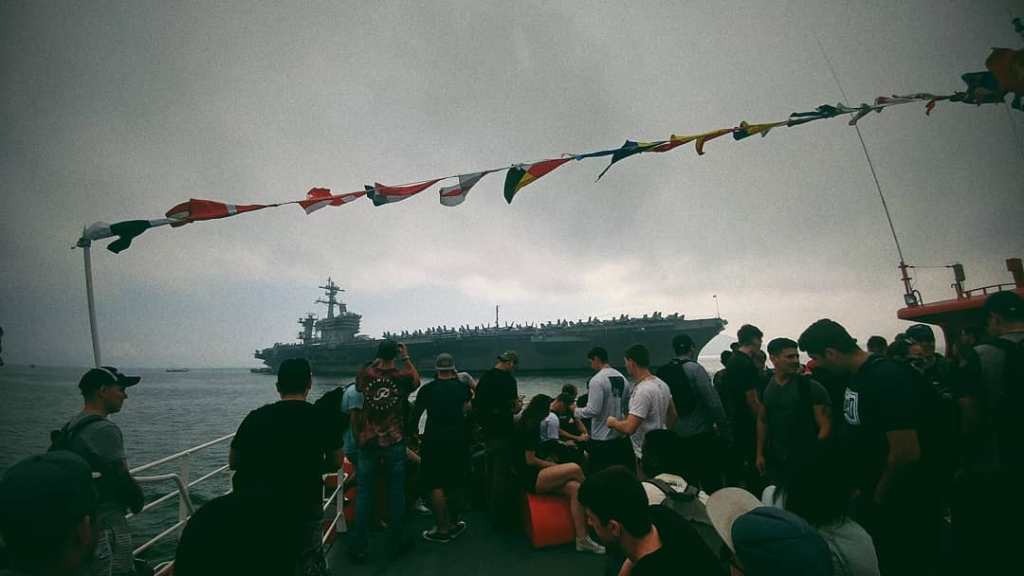
The aircraft carrier is a marvel colossus. It is a floating steel village that houses approximately 3000 sailors: a microcosm within a microcosm within a microcosm. Much like every habitable ecosystem I find myself living in, I have developed a routine for survival.
Every morning after a quick shower and a poor excuse for a breakfast fit for jailed prisoners, I make my coffee and sit in my office meditatively staring at nothing in particular. Sometimes my mind will drift into thinking about where we are, floating somewhere in the middle of the sweltering hot Philippine Sea, and how fortunate I am to have a desk job that does not require me to do any manual labor like the mechanics, who are currently sweating through their flight deck jerseys in the hangar. After about 15 minutes of doing so, I take a walk three decks down into the hangar bay passing several packs of sailors already covered in oil and grime. After the flight deck, the hangar is the second most brutal area of the ship: a place where the strong scent of jet fuel and the sounds of cracking, whirring, and grinding power tools viciously attack one’s senses. From the hangar bay, I then head out through a hatch that leads me to a small smoking area on the outer skin of the ship. Here, I’ll smoke a cigarette, stare at the ocean, and allow my mind to wander with the waves.
As a seasoned sailor, in my fourth deployment on an aircraft carrier, this ritual was essential to my survival. I’ve seen strong people go mad four months into an eight month deployment because they never adjusted their survival methods from land. Many sailors never develop rituals. They survive the deployment, but they don’t thrive within the ecosystem. Sailors that thrive in this microcosm adapt. Airman Keona, a subordinate junior sailor of mine, was someone I watched master the art of ship survival one day during an encounter with wolves.
She sat next to me in a small office compartment on the ship just below the flight deck. A young hard-working native of Hawaii who joined straight out of high school. She was unmistakenly of islander quality, broad through the hips, of sturdy stature bronzed from the pacific sun shaped to battle ocean currents. She moved through the ship deer-like, with light-footed elegance and grace, despite being forced to wear Navy issued heavy steel-toed work boots. Her large doe-eyes made it hard for any of her superiors to speak to her with the same sharp authority they used on everyone else. On normal days, Keona wears a sunny optimistic smile. Unfortunately, no days are ever normal aboard a carrier.
“God I can’t wait to go back home,” she’d mutter on several occasions. Whether she meant San Diego where we were stationed, Long Beach where she previously lived, or Hawaii with her extended family, it mattered not, she simply meant back; back before she stepped foot on this ship. That longing was always a sign of failure to adapt within the ecosystem.
In our office, the ship’s machinery quietly hummed throughout the day, intensifying the dreariness. The F-18 fighter jets slamming down on the flight deck just above us used to be exciting, but at this point late into deployment, they had been reduced to background noise. I sat in my office chair facing the opposite direction of where my work awaited. Mid-meditation, coffee in hand, I heard the ship’s air conditioning system click on. The low hums of the ship grew noticeably louder, and out of the corner of my eye, I saw Keona shivering and rubbing her arms. My meditative stare turned into an observational one as I watched her stand up and grab an enormous, blue, XXXL puffy flight deck jacket that was hanging on a nearby wall. When she donned the jacket, it looked like she was being swallowed whole against her will. I took a sip of my coffee as I watched her zip the jacket all the way up to her bottom lip and return to her work.
Just outside of our compartment I could hear the rhythmic clanking of metals followed by footsteps and some light laughter that sounded like howling. The combination of noise grew louder as it approached my office. At the peak of its volume, four aircraft mechanics appeared at my door. They announced their presence by exhaustively dropping their large white toolbox on the deck in front of them creating a sound similar to a hammer meeting a large window, a celebratory release for them after a difficult task completed. Now the wolves are hungry and thus begins their hunt. The leader of the pack wiped the sweat from his face and exhaled.
“Yo, AZ2,” this was my Navy name, a combination of letters followed by a number to represent my job and rank. The lead mechanic slapped his sweat-drenched hand on my back; he needed a favor. His entire body was radiating with heat from working in the hangar all day.
“Take a step back, I can feel the hangar radiating off your sweaty ass,” I replied jokingly. This drew some laughter from the other mechanics still waiting at the door.
“You’re free to join us if you’d like.”
“I’ll pass, thanks. What do you need?”
He wanted me to look up some aircraft inspection dates. As I went to work to fulfill his request, the mechanics began to joke around and poke fun at each other, a common form of time dissolution on the ship: predatory behavior.
“Bro, did you see how Sherman hopped off that ladder? What a fucking sissy!” One wolf said to another.
Sherman shoved his fellow wolfpack member, “I was trying not to roll my ankle asshole!”
When they got bored beating up on each other, their eyes began to slowly shift toward other nearby prey, a deer perhaps. Keona was still wrapped in her massive blue puffy safe space, a stark contrast to the sweating oil-covered mechanics—The perfect candidate.
“Hey Keona,” one of the wolves loudly snarled, “just so you know, we have bigger jackets in our shop if that one’s not warm enough for you.” The mechanics began to howl in unison. I smiled, because I knew it was coming. The optics of Keona wearing the jacket in a cool office while they suffered in the suffocatingly humid hangar irked them the moment they walked in.
Keona gave the mechanics a nasty little look and waited for them to stop laughing. When they stopped, she gave them the dissatisfaction of not replying. Instead, she pulled out her headphones, drowned out the noise, and went back to work. Escapism is surviving.
Sherman slapped the heckler on the arm, “Damn, look what you did, she hates us now.”
“Keona,” the wolf called out. “Hey, Keona!” No reply.
“Aww, she must be too cold to talk,” they said as they chuckled.
“Hey Keona! You’re never gonna make it on this ship if your skin’s too thin to handle the AC and a little shit talking.” The wolves again were howling, harder this time. At this point I couldn’t tell if their sweat was still from all their hard work in the hangar, or new sweat built up from laughing so hard.
I wrapped up their request and set the wolves on their way. They left loudly, howling as they went. After they left, I kicked Keona’s chair to get her attention. She removed her headphones.
“What?” She asked, clearly annoyed.
“It is kind of crazy you’re wearing that big ass jacket while those guys are dying out there in that heat. It’s like a visual slap to their face.” I said laughing. I wanted to lighten her up, but it wasn’t working.
“So what? It’s not my fault they picked a stupid job.” She looked up, not to hold back tears, but instead as if she was looking toward God for an explanation for the wolves’ stupidity.
“Okay, true. I just think sometimes, small little sacrifices like not wearing a huge jacket in an air conditioned office in front of sweaty disgusting mechs goes a long way. It’s a long deployment you know?” She rolled her eyes, shook her head, and put her headphones back on. She was annoyed at me too now. She kept the jacket on.
It dawned on me later that evening that the jacket meant even more to her after the mechanics joke. Ignoring the wolves completely was her way of retaining a win in a microcosm where we get so few. She’d sent a message that day. Escapism and defiance were just her methods of survival. In a system where everything is regulated, the jacket was one small zone of autonomy she refused to surrender. Sailors act on what works, whether it be short meditation breaks, smoking cigarettes, heckling, joking around, escaping through music, or wearing the biggest jacket ever made in a chilly air-conditioned office. Maybe Keona knew more about surviving in new ecosystems better than everyone else did. Keona taught me that day that if you ever find yourself in an environment where big wins are seldom, then you need to capture the little ones, and you need to hold on to every single one of them. Even if it is a jacket. Keona must imagine Sisyphus happy.
The next day, I heard the air conditioning system click on again during another small stretch of quiet. Like a trained dog, I glanced over at Keona who, on cue, looked back at me. We stared at each other for a few moments before I raised an eyebrow: “What? No jacket today?” Keona said nothing, just smiled, put her headphones on, flipped me off, and went back to work. I smiled back, took a sip of my coffee, and went out for a smoke to stare at the waves, a jacket of my own.
 NEW REVELRY
Leave a comment